A Halo Signifies Divinity in Both Hindu and Christian Religious Art Quizlet
5.three: SYMBOLISM AND ICONOGRAPHY
- Folio ID
- 10138

Symbolism refers to the apply of specific figural or naturalistic images, or bathetic graphic signs that concord shared pregnant inside a group. A symbol is an image or sign that is understood by a group to represent something. The symbol, however, does not have to take a direct connection to its meaning. For example, the letters of the alphabet, which are abstract graphic signs, are understood past those who use them to have individual sounds and meanings. The users accept assigned meaning to them, as letters take no meaning in and of themselves. An example of a naturalistic paradigm is a rose, which in almost Western civilizations symbolizes dearest. When ane person gives a rose to another, it is a symbol of the honey the person feels.
Iconography is the broader study and interpretation of subject matter and pictorial themes in a piece of work of art. This includes implied meanings and symbolism that are used to convey the group's shared experience and history—its familiar myths and stories. Iconography refers to the symbols used inside a piece of work of art and what they mean, or symbolize. For example, in different cultures a snake may stand for evil, temptation, wisdom, rebirth, or the circle of life. A depiction of a ophidian in a scene with Adam and Eve has specific meanings for those of the Christian religion or others who understand the serpent stands for temptation within the context of that subject or story. In Chinese culture, nevertheless, a snake represents the power of nature and is said to bring good fortune to those who practice the serpent's restraint and elegance of motility.
5.iii.i Changes in Meaning of Symbols and Iconography
While a symbol might have a common meaning for a certain group, it might exist used with variations by or hold a different significance for other groups. Let usa apply the example of a cantankerous. At its core, a cross is a uncomplicated intersection of vertical and horizontal lines that could refer to the coming together of celestial and terrestrial elements or forces or could lend itself to other variations of meaning. The cantankerous most frequently associated with Christianity is the Latin Cantankerous, with the long vertical bar intersected by a shorter horizontal 1 believed past many to be the course of the cross upon which Jesus Christ, the key figure of the faith, was crucified. (Variants of the Cross: http://wpmedia.vancouversun.com/2010...6.crosses1.png) Only its simplicity of formulation lends itself to various other readings, also, and in pre Christian use it was related to sacred and catholic beliefs.
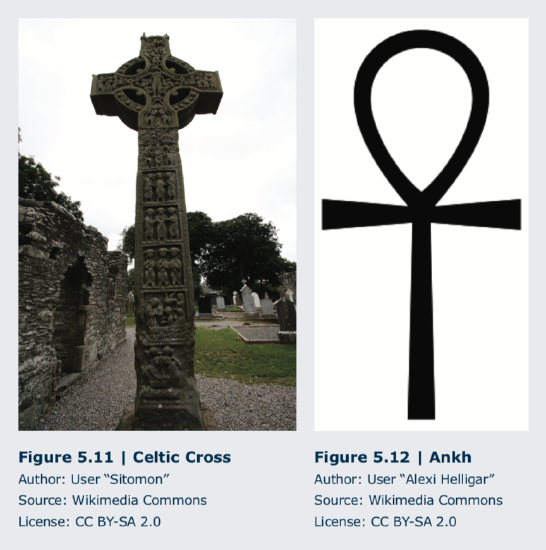
Within Christian usage, the cross has taken a bully number of different of forms, including the equal-armed Greek Cross, favored by the Byzantine Christians; Celtic crosses, with a circular add-on to the crossing; X's and upside-down crosses associated with specific Christian martyrs, individuals who died for their faith, on such instruments of torture; and many others. In fine art, we might see them equally elementary flat graphic works, or decorated in two-dimensional renditions, or equally fully developed three-dimensional interpretations, similar the numerous grave markers in Irish cemeteries, where they are further embellished with intricate motifs and iconographic depictions of Bible stories. (Effigy 5.11)
The Ankh, another cross form, with a looped handle, seems to have been devised by the aboriginal Egyptians every bit a symbol of the life-giving power of the Sun. (Figure 5.12) It was one of the numerous pictographic symbols they used both every bit a dissever sign and every bit office of the hieroglyphic organization of writing they adult.
Clearly, many other symbols take various meanings, especially when they are represented equally more abstruse graphic signs. To read their implications in whatsoever particular application will require your considering where it was made and for what specific purposes, as well as how it might have been adopted and turned to unlike use at that time or after. Sometimes the shifts in meaning may be radical, as in the form of the swastika, an aboriginal sacred sign used in many dissimilar cultures, including India and others throughout Asia, as well as the Near E, and Europe. (Figures 5.13, 5.14, and five.15) It has historically been a very auspicious sign with implications of adept fortune and positive movement, and was therefore adopted for the ground plan for Buddhist stupa worship centers. Of course, in the twentieth century, its appropriation by the Nazi Party as a symbol of the superiority of the Aryan heritage led to very unlike and now mostly negative connotations.
Iconography is often more than specific and definitive, with concrete reference to globe experiences and, beyond that, to some form of narrative for the group involved. Once more, analysis of the pictorial form requires examination of the con- text in which the artwork was created. We can and must expect at the underlying narrative, but, as we shall discuss in the adjacent several capacity, the pictorial expressions evolve both independently of the narrative sources and in response to narrative and artistic change.


For case, Christians (more specifically that branch now known every bit Roman Catholics) debated the "truthful nature" of the Virgin Mary, the Mother of Jesus Christ. Amidst the points of argue was whether Mary was bodily in Heaven with her Son or whether she had to look until the end of fourth dimension when the whole of flesh would experience actual resurrection, that is, at the fourth dimension of the 2nd Coming and the Last Judgment, when everyone would accept their lifetime of deeds assessed for purposes of learning whether they would spend eternity in Heaven or Hell. These Christian ideas are among those a great corporeality of art has been devoted to over fourth dimension.
To illustrate, we can wait at differences betwixt two works about Mary and her identify and part in Heaven that appeared in church relief sculpture during the twelfth and thirteenth centuries. These differing ideas focused on the unsaid elevation of Mary to a divine status, or to her non being seen equally divine herself, in which instance, the faithful needed to keep a view of her as beingness in a more subordinate or secondary status. The questions included consideration of Mary as the "Queen of Heaven," who might be ruling aslope her son. At Senlis Cathedral (1153-1181) in France, she was depicted as obviously a co-ruler with Christ, simply ensuing theological discussion took issue with this possible over-elevation. (Effigy 5.sixteen) So, while the renditions of Mary as the celestial queen continued in popularity, they made information technology clear that she was only considered to be there at the bidding and will of Christ. This can be seen at Chartres Cathedral in French republic, where she bows her head to Jesus. (North Portal of Notre-Dame Cathedral: https://www.bluffton.edu/~sullivanm/ chartresnorth/cportal.html)
What nosotros see here, again, is that our total analysis of the artworks we encounter needs a complex arroyo that includes a diversity of visual clues and a wide range of inquiry on the contextual details of its cosmos and employ. In contrast to the longstanding exclamation that "dazzler is in the center of the beholder," the appropriate estimation co-ordinate to the intended symbolism and/or iconography must take the lodge, civilisation, and related circumstances into business relationship to accurately reflect its intended meaning or original meaning for viewers. We will be exploring these ideas in greater item in the next several chapters.
5.3.2 Symbolism, Iconography, and Visual Literacy
Symbols like the cantankerous or the swastika will only accept shared meaning for those who agree upon and affirm a specific interpretation, which can be positive or negative for whatsoever particular group of people. This specific meaning in symbols is always going to exist the case for viewing of whatsoever visual expression, whether in simplified graphic sign course or a more detailed pictorial rendition. Additionally, the viewers must also frequently have some measure out of instruction near how to view a particular work so they can empathize its meaning more fully.
 As well noteworthy is that members of any group use art as a means of sharing ideas and sentiment, as well as for expressing and education credo. While the didactic uses of art have ofttimes been discussed in terms of educational activity for the non-literate, we should recognize that the meanings of pictorial content and the tools used to create the moving-picture show must exist learned also. The apparent superficial meanings that are axiomatic through unschooled visual exam do non produce the level of comprehension available in a more fully developed illustration of a tenet of a faith, political message, history lesson, or nautical chart or graph of economic trends. So "visual literacy" should be considered a skill related to verbal and reading literacy for any didactic part. Simply members of a group who have been led to understand and perceive the underlying principles volition know how to "read" an illustrated bulletin.
For example, we can look at the Ritual Vase from Warka (today Republic of iraq) or the Seven Sacraments Altarpiece past Rogier van der Weyden. (The Warka Vase: http:// dieselpunk44.blogspot. com/2013/08/the-warka- vase.html) (Figure v.17) 1 could likely identify the basic pictorial content of either piece of work, but further knowledge would be needed to analyze them further. If you were a member of the intended audience, y'all might have a chip more insight into what each artist had created in pictorial terms, but even the initiated viewer would likely have a express "reading" of the work.
In the case of the Ritual Vase from Warka, fifty-fifty if you lot had lived in ancient Sumer and had been a devotee of the goddess Inanna, you would likely need further instruction about how the carvings on the different registers of the vase were arranged to show the cosmological conception of the created globe. That is, one starts at the bottom with the primordial earth and waters, moves to the plants and animals to a higher place them drawing sustenance so that they could be harvested and herded by the humans, who and then offer role of their gleanings to the goddess serving them from the temple as seen in the upper realm of the middle photo. This blueprint would be further explained as a neatly hierarchical arrangement, in which the levels of the created world were presented in different sizes, co-ordinate to their relative importance. Additional meanings could be layered upon this brief explanation with repeated instruction occasions and viewings.
The Seven Sacraments Altarpiece was painted past Rogier van der Weyden in a region and an era of tremendously complicated iconography: Flanders during the Belatedly Gothic/Northern Renaissance menses. The presentation here includes detailed pictorial description of each of the seven sacraments that marked the stages and stations of Christian life. This symbolism again developed over time, and often in response to theological writings that informed the creative person and the viewer about specific meanings. The written sources are detailed and complex, with the pictorial rendition richly reflecting what the well-instructed Christian would know nigh these important rituals and their furnishings.
The larger primal panel of the triptych, or three-part, format was used by the artist to emphasize the Crucifixion equally the ascendant overarching outcome that is related to each of the sacraments. Additionally, he provided angels with scrolls to identify them as if speaking to the viewer. So, here the messages are both pictorial and inscribed, and the iconography is a complex program that relates all these ritual events to the whole of the Christian life and religion. Truly, the viewer must be an initiate to discern the meanings behind all the symbolism or a scholar to find them. Nonetheless, even the coincidental or uninitiated can read much of what is present in the painting and can identify both familiar elements and those that might lead y'all to further investigation. This is often the job and the path in interpretation of iconography in art.
five.iii.3 Symbolism and Iconography in Mythology and Storytelling
From early, fine art contained expressions of mythical accounts that people shared about their beliefs and ways of living. From the time of the first great civilizations, for example, in Egypt, the Virtually East, China, Nihon, and India, artwork related to the stories of the people. The caste to which whatsoever contemporary written sources confirm these interpretations varies, but that these myths had commonly understood meanings for the people for whom they were made is confirmed past both their frequent advent and their apparent places in their civilisation's artistic traditions, sometimes over centuries. Artistic iconographic traditions therefore show potent relationships to beliefs and practices known from written sources—although written documentation sometimes does not appear until later times.

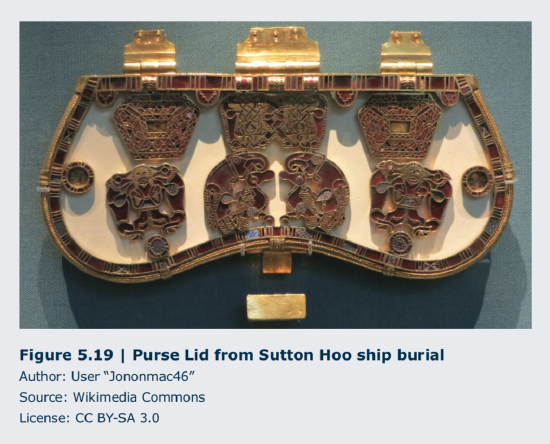
Because early stories were oftentimes passed forth through oral tales, we exercise not always have a literary record of them until later times, even subsequently the ideas had been expressed symbolically in pictorial fine art. An example of this symbolism may be found in the rich hoard (a collection of objects) known as the Sutton Hoo Send Burial, plant in England and deriving from the early Heart Ages era known equally the Migration period (300-700 CE). Although the wooden ship itself has disintegrated, the burial hoard it contained provides details that ostend and augment our incomplete understating of the adventurous societies of that time and their beliefs about needs for the afterlife. The diverse objects also lend certain insights into the epic tales of such warrior kings every bit Beowulf, whose story seems to have been a long-standing oral tradition, one perhaps re-told for centuries before existence commit- ted to written form. The lavish ornaments, such as this chugalug buckle and purse cover, give visual testimony to the tales of dragons and heroes similar Beowulf through their expressive and intricate patterns and rich materials. (Figures 5.18 and 5.xix) The fine metalwork on the purse cover is cloisonné,which is created by affixing gold or metallic strips to the back surface, making compartments, that are filled with powder (in this instance, ground garnets) and heated to 1,400-1,600 degrees F.
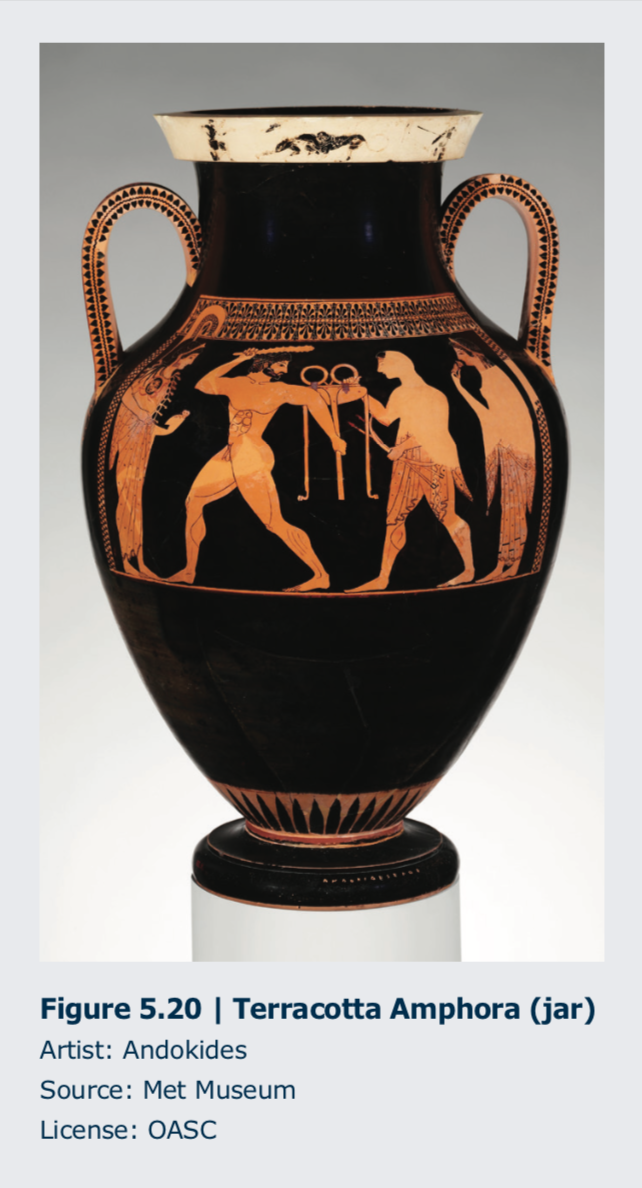
 The fine art of ancient Hellenic republic often showed smashing concern with the stories of Greek mythology as well. Tales of the gods and warriors grow, including those nigh not bad concrete or intellectual contest, such as the well-known struggles of Herakles (known as Hercules under the Romans) ane of which is seen on this amphora. (Figure 5.20) Such tales were very familiar, and viewers were expected to supply the details of the rest of the story through the parts that were shown. Nevertheless, the good artist can enliven the presentation of the figures with posture, gesture, expression, and such symbolic props equally the club and the tripod Herakles holds.
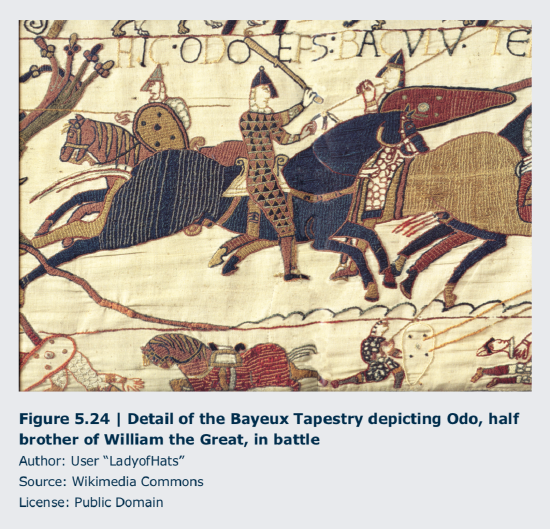
As with literary accounts, the artworks associated with historical and legendary events frequently include a very wide range of symbols and imagery to help convey ideas. These range from mundane details to grand historical moments, every bit in the Column of Trajan, nearly 100 feet in height, which commemorates the military campaigns of Roman Emperor Trajan (r. 98-117 CE) confronting the Dacians (101-102 and 105-106 CE) in 155 scenes. (Figure five.21) Or equally announced in the Bayeux Tapestry, an embroidered cloth 230 feet in length that pictorially recounts the events of the Norman Invasion and Battle of Hastings in 1066. (Effigy five.22) Each of these works shows decisive points in their respective historical events in army operations and in the details of the difficult work involved in preparing for battle. (Figures 5.23 and 5.24) In this manner, they provide u.s. with glimpses of everyday life in the corresponding eras aslope specific details about the particular campaigns, the cultures in which they were significant, and the individuals who were fundamental players in the historical events. The details of arms and armor, organized troops and chaotic fighting, building of defensive structures and devices, moments of victory and defeat, and innumerable other items and activities—all are individually and collectively efficient means of recounting the evolution of the events which, in each of these works, is dramatically developed across a long scrolled compositional field that further emphasizes the lengthy narrative each i progressively disclosed.


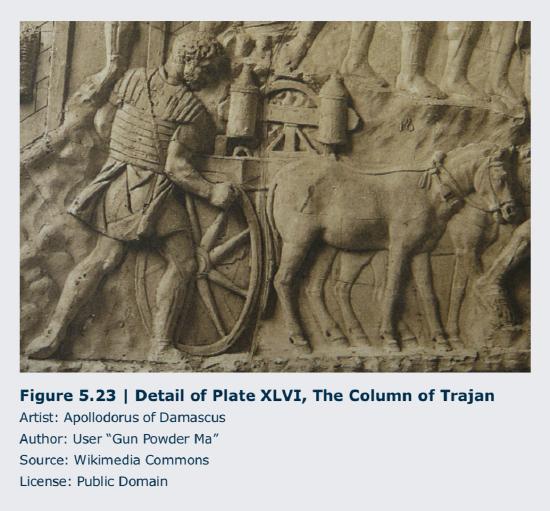
Similar many works of public art of the Roman Imperial era, the column glorifies not simply Trajan (the base of the column was designed to contain his ashes) and his deeds, just also the ideas of imperial rule, the part of conquest in expanding the Empire, and the skilled work of Roman soldiers in battlements and tactics. Past contrast, the Bayeux Tapestry has more emphasis on the actual tumultuous battle scenes replete with mounted cavalry in chain mail and elaborate helmets but it also includes a swell deal more sense of historical con- text: events leading up to the 1066 Boxing of Hastings subsequently the death of Rex Edward the Confessor (r. 1042-1066) and his burial in the newly refurbished Westminster Abbey he had adopted every bit his royal church building. Both of these works likewise include inscriptions that explicate ideas and events, besides as serve to further present the political messages nigh the battles presented on the tapestry in a sort of scene-by-scene narrative over again, for each, underscoring the relationships betwixt literary and pictorial presentations of ideas.
 5.3.4 Exploring Symbolic and Iconographic Motifs
Such items as artillery and armor are obvious sorts of symbols that conspicuously depict their purposes, only much symbolism that we see in other artworks has more veiled and variable meaning. Such simple items as flowers and candles can be used in very complex means in pictures that bear various meanings, thus requiring careful study and even deep research in order to discern their implications in a particular work.
For example, the Merode Altarpiece past Robert Campin (c. 1375-1444, Belgium) depicts the Christian story of the Annunciation to the Virgin Mary past the Angel Gabriel that she will become the Mother of Christ, the son of God. (Figure 5.25) This work is total of symbols that have been widely studied to discern and interpret their messages. The lilies are generally interpreted to symbolize the purity and virginity of Mary in other pictures, though, they might have other meanings, including reference to death, resurrection, birth, maternity, or other events or atmospheric condition. Inside this one work, the use of the candle, just extinguished with a trail of smoke, is given several different meanings by diverse viewers and scholars. It might show the moment of acquiescence, when Mary agrees to bear the Christ child, in which God takes human form. Information technology has too been read equally a foreshadowing of Christ's death, of homo death in general, and of the fleeting nature of life for all.
In the fourth dimension and place of the altarpiece'due south creation, symbolism in paintings was particularly apt to be rich and varied, offering the viewer/believer a lot to see and to contemplate further. In this fashion, if the symbols could exist read in dissimilar ways, they could and then provide ongoing stimulus for meditative reflection on the diverse levels of pregnant.
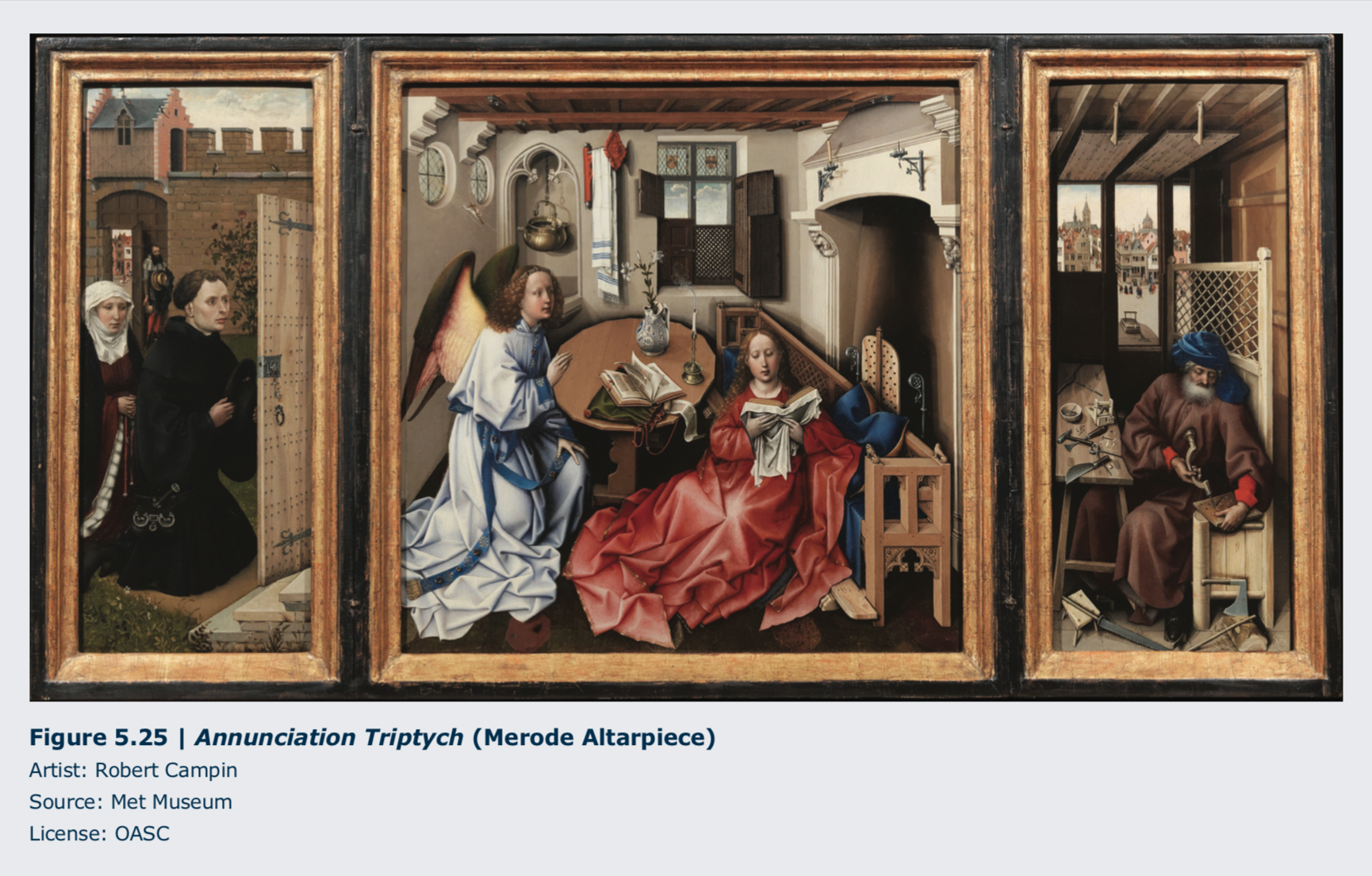

For example, the Merode Altarpiece past Robert Campin (c. 1375-1444, Belgium) depicts the Christian story of the Annunciation to the Virgin Mary by the Angel Gabriel that she will become the Mother of Christ, the son of God. (Effigy v.25) This work is total of symbols that have been widely studied to discern and interpret their letters. The lilies are mostly interpreted to symbolize the purity and virginity of Mary in other pictures, though, they might take other meanings, including reference to expiry, resurrection, birth, motherhood, or other events or conditions. Inside this one work, the use of the candle, but extinguished with a trail of smoke, is given several different meanings by diverse viewers and scholars. It might evidence the moment of acquiescence, when Mary agrees to carry the Christ child, in which God takes human form. It has also been read equally a foreshadowing of Christ'south death, of man death in full general, and of the fleeting nature of life for all.
In the fourth dimension and place of the altarpiece's creation, symbolism in paintings was particularly apt to be rich and varied, offer the viewer/believer a lot to see and to contemplate farther. In this way, if the symbols could be read in dissimilar ways, they could then provide ongoing stimulus for meditative reflection on the diverse levels of pregnant.

 And some symbolic motifs, distinguishing features or ideas, comport different meaning in one context from what they might in another. Nearly symbols are not universal, although they oft comport related meanings in various contexts. For example, the sort of figure you might identify as an angel, that is, a winged creature with a human being-like bodily form, has appeared in the fine art of many different cultures. They generally stand for beings that can travel between the terrestrial and celestial realms, but their more specific roles can vary widely, for good or evil purposes. The Angel Gabriel, simply seen in the Merode Altarpiece, was a messenger from God, according to the Christian tradition. This motif was congenital upon the Jewish tradition of angels sent from God for bringing news or instructions, or intervening equally needed. Islamic interpretations, also edifice on the same traditions, are similar although the figural representation is less common in Muslim artwork.
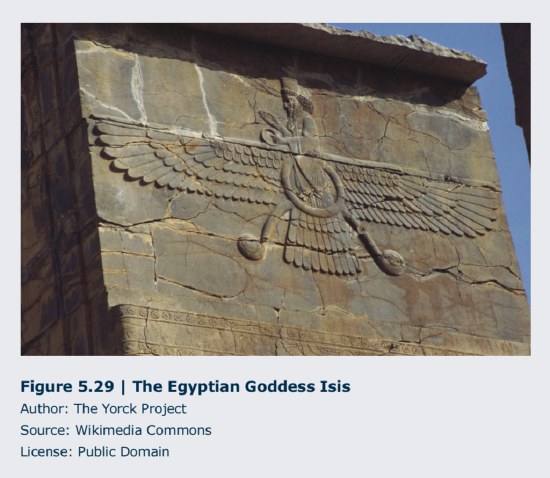
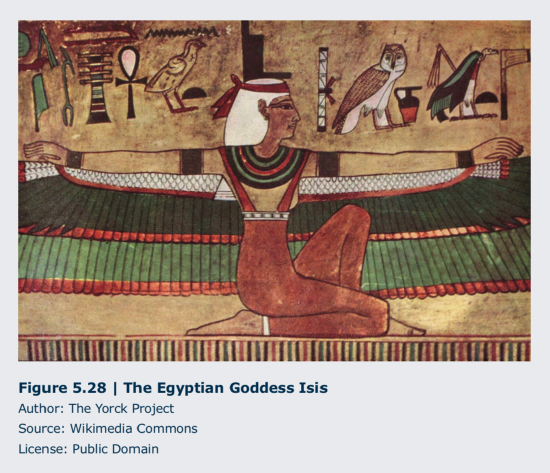
Prior to such figures, winged creatures known as Nikes were depicted by ancient Greek and Roman artists to bear witness a moment of victory, sometimes, as is the case hither, further symbolized by the award of a fillet, a band wrapped around the head, or laurel wreath. (Effigy v.26) These winged figures were sometimes gods or goddesses. The genie figures that adorned palace walls in the ancient Near Eastward, including horses, bulls, lions, and other animals, were likewise winged to testify their superior and sometimes god-similar powers or origins. (Figure 5.27) Other examples include the goddess Isis of an- cient Arab republic of egypt, and the Persian god Ahura Mazda. (Figures 5.28 and 5.29)
Another prepare of prominent Christian iconographic motifs are the winged symbols which often stand for the Iv Evangelists in art: Matthew is the winged man or angel; Marking, the winged lion; Luke, a winged ox; and John, an eagle. (Effigy 5.30) At the aforementioned time they refer to four key events in the life of Christ: the Incarnation, Passion, Resurrection, and Rise. Interpretations of these evangelist symbols are rooted in the Quondam Testament Vision of Ezekiel and the New Testament Book of Revelation, as related by the writings of St. Jerome in the fifth century CE. They accrued additional iconographic details over the centuries, with implications of their condition as the special creatures who surroundings the celestial throne of God once again, signifying that the wings facilitate motion between the realms traditionally ascribed to a deity, a god or goddess, and divinely related creatures. This use of wings clearly reflects homo contemplation of the abilities that birds have to defy gravity and to express artistically the lofty aspirations of the earthbound.
Another frequently used iconographic motif that appears across the ages and across cultures is the halo, usually a circular area of light appearing behind the head of a person or creature. One example is the halo that appears behind the heads of Christ and the symbolic winged creatures in Figure 5.30. Note that Christ's halo has a cross form embedded in it, and his entire body is surrounded past a circle of light (made upwards of 4 arcs) known as an aureole or mandorla. Such devices, in many related forms, indicate a radiance that surrounds certain figures, showing their sanctity, divinity, or divine favor. It indicates their aura of holiness, with implications of their being infused with warmth, inflamed with divinity or with divine dear. In some of the Asian versions, notably Hindu or Buddhist, the radiance is literally comprised of flames.
Often seen, as well, are such items as crowns, thrones, regalia similar scepters, garments like official capes, monks' robes, or uniforms of all varieties indications of a person's belonging to a specific group, grade, or role that atomic number 82 the viewer to place some specific aspect of who the person might be and what function they have in the delineation. The positioning of figures relative to one another should also be read in gild to discern meaning, interactions, relative rank, and other implications. The types of garb, accompanying items, and positioning often relate the message to a specific time and place by giving historical and cultural context through details of style or motifs used.

 For case, on the stele depicting his victory over the Lullubi, the Akkadian ruler Naram Sin (r. c. 2254-2218 BCE) wears a horned helmet and is much bigger than the men around him. (Figure five.31) He ascends the mountain every bit his enemies beg for mercy under the spotter of astral deities, and that shows his relationship to them equally the source of his power and right to dominion. In the Ghent Al- tarpiece by Jan van Eyck (c. 1390-1441, Belgium), we can also see a diverseness of such motifs: Christ, wearing the papal ti- ara as a crown; Mary, richly dressed and humbly reading; and John the Baptist, in his garment of penitence, and preaching. (Figure 5.32) Adorned with jewels and gold on his clothing, the throne on which he sits, and the crown at his feet, Christ is here being shown every bit the king of Heaven every bit well as Earth.
5.3.5 Metaphorical Meanings
The metaphorical meanings of specific artworks also depend upon a sure level of viewer knowledge and insight. A metaphor is a figure of speech in which one thing symbolically stands for another, perhaps unrelated, thing or idea.
In 1550 Chairs Stacked Between Two Urban center Buildings by Doris Salcedo (b. 1958, Columbia), nosotros come across a metaphorical handling of life change. (1550 Chairs Stacked Between Ii City Buildings, Doris Salcedo: http://www.mymodernmet.com/profiles/...due south-salcedo-1550 chairs-stacked) It is a view of deportation resulting from a 1985 uprising in her Colombian homeland that left many migrants displaced or dead, too as similar catastrophic events in locales across the globe. The jumbled mass of article of furniture alludes to the upheaval of lives that are overturned by mass violence and terrorism, often of those already without roots, customs, or stable lifestyles. The victims, ofttimes anonymous and relatively invisible in the site of such a defection, nonetheless left some hints of their presence in the chaotic remnants of their fleeting being, in a place where they had established so little sense of their private identities. Her metaphorical expression gives a probing glimpse of the devastation such events take wrought around the earth.

maldonadoouction1987.blogspot.com
Source: https://human.libretexts.org/Bookshelves/Art/Book%3A_Introduction_to_Art_-_Design_Context_and_Meaning_(Sachant_et_al.)/05%3A_Meaning_in_Art/5.03%3A_SYMBOLISM_AND_ICONOGRAPHY

Post a Comment for "A Halo Signifies Divinity in Both Hindu and Christian Religious Art Quizlet"