Calories in Raw Vs Cooked Beef
A very common question people take in regards to tracking their food is: "do I counterbalance my food raw or cooked?"
Truthfully, yous tin can do either, equally long as you're consistent with it.
I always recommend weighing raw ingredients whenever possible, because it is always going to exist the most accurate. When you cook food, there are various cooking methods, sauces, ingredients, etc, that can all affect the final cooked weight.
When you lot stick with the raw weight, you eliminate all of those variables.
That's not to say that weighing your cooked nutrient is inefficient, merely let's explore why weighing food raw is about constructive…
Nutrition labels always display data based on raw weight

The nutrition facts of your food will e'er be based on raw weight, unless otherwise specified.
Most packages of bacon will say "2 pan-fried strips" equally a serving, which refers to cooked salary. Otherwise, if it doesn't specify, it implies that the nutrient is raw.
Let's look at footing beef as an example.
A single serving of 4 ounces of footing beef is based on 4 ounces raw ground beef.
When you cook that footing beef, those iv ounces volition cook downwards to nearly 3 ounces.
If yous were to track the 3 ounces of cooked meat, you would track it as 4 ounces of raw meat every bit seen on the nutrition characterization.
How can iii ounces of cooked meat have the same nutrition every bit iv ounces of uncooked meat?
The only thing changing here is water weight. When the meat cooks, it loses water. Nothing else is changing!
This is where people get dislocated, and so I want to say it once more.
Even though meat weighs less, the nutrition is still exactly the same.
Practice calories or macros modify when you cook nutrient?
Whether yous're weighing your food raw or cooked, the calories aren't changing.
This throws a lot of people off. How tin ii ounces of raw rice have the same calories every bit 4 ounces of cooked rice?
Isn't information technology double the amount?
Not exactly.
Sticking with the example of rice, when you melt it, all you lot're doing is humid it in h2o. The rice absorbs the water, leading to the serving doubling in size.
While the nutrient weight has doubled, the volume is nonetheless the same. You have the same exact amount of rice!
If you take a 4 ounce serving of cooked rice, it has the same exact calories as 2 ounces of uncooked rice.
Raw to cooked conversions for various foods

If you lot're reading this, you likely want to know how to practice the conversion from raw to cooked weight, or vice versa.
Each food conversion is dissimilar, and there are quite a few variables to take into account so no conversion is going to exist 100% accurate all the time. We're going to dive into some actual conversions, but remember that at that place are some factors that can affect the weight:
- Different cooking methods will yield different weights. We're going to await at standard cooking methods (like grilling chicken) but something like an air fryer may yield a slightly different weight due to the way information technology cooks.
- Sauces and condiments will impact your cooked nutrient. If your meat has a marinade on information technology, the concluding cooked nutrient may be slightly heavier than we'd usually look, but it's not enough to worry about.
- Each nutrient has different types that may melt slightly differently. Pasta has a ton of different shapes that use unlike ingredients, there are tons of dissimilar cuts of meat, etc. The following conversions are estimates , but they'll definitely exist close enough for our purposes.
Raw vs cooked meat weight conversion
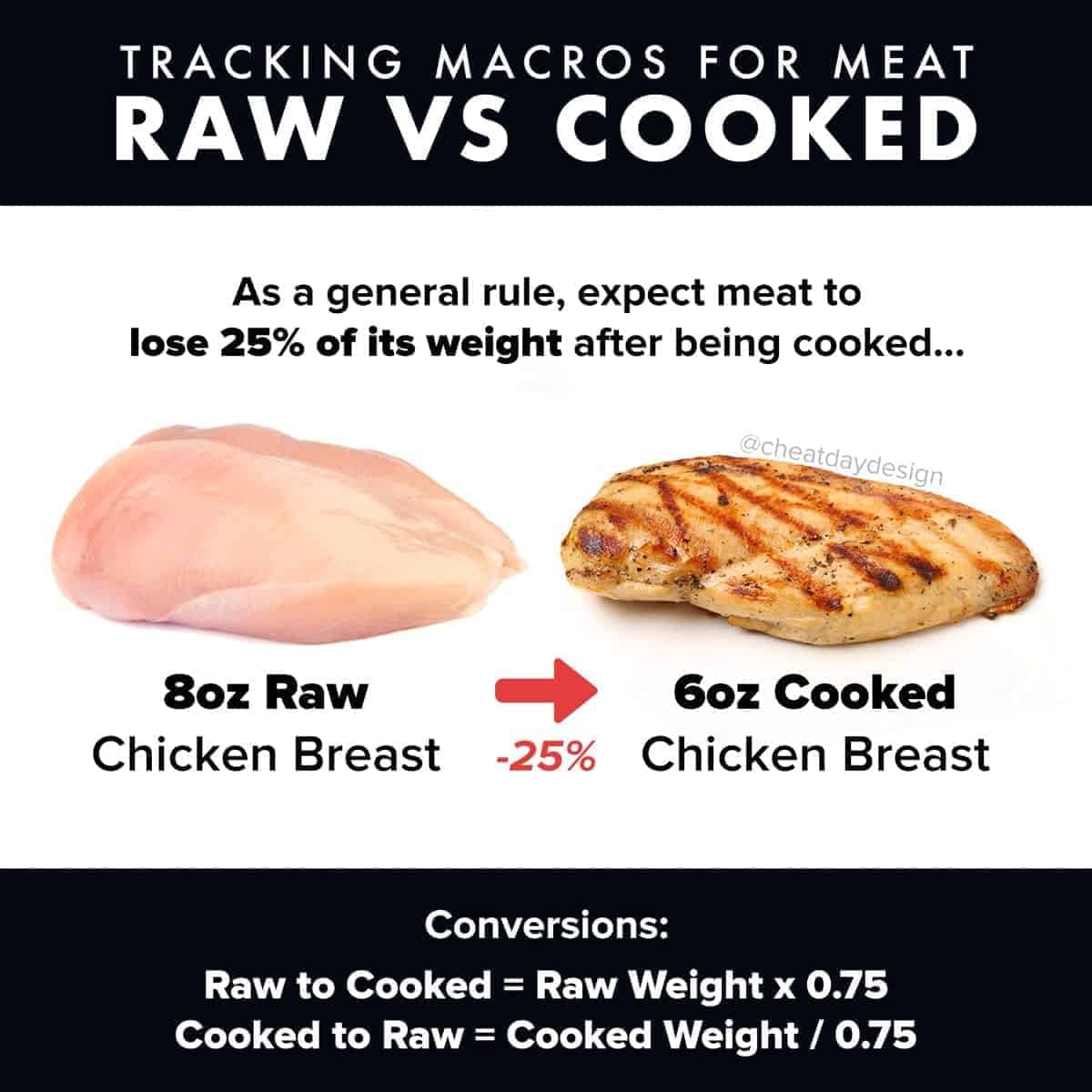
Raw to cooked meat conversion: Raw weight x 0.75 (example: 4oz raw x 0.75 = 3oz cooked)
Cooked to raw meat conversion: Cooked weight / 0.75 (example: 8oz cooked / 0.75 = 8oz raw)
While it will vary slightly depending on the type of meat you employ, you can safely presume that cooked meat volition lose about 25% of its weight once it's cooked.
I've personally tested this a scattering of times with craven breast and tin confirm that it is quite accurate. If you're looking at cooked vs uncooked chicken, information technology will almost e'er melt down from 8 ounces of uncooked chicken to six ounces of cooked craven.
If you are looking at the nutrition facts on a packet of meat, it will exist based on raw meat weight.
For ease, I recommend weighing the raw meat before cooking to have out all the guesswork. You volition likely be adding spices, sauces, or marinades during the cooking procedure, which can affect the final weight.
But at that place are certainly cases where you'll only be able to weigh your cooked meat, especially if somebody else is doing the cooking, and that'southward where this conversion comes into play.
If you find yourself with an 8-ounce portion of cooked chicken, you lot tin divide it by 0.75 to find that the nutrition will be equal to roughly eleven-ounces of raw chicken. It may not be exact, but that will be a very close estimate.
Uncooked vs cooked pasta weight conversion

Raw to cooked pasta conversion: Raw weight ten ii.25 (example: 2oz raw 10 2.25 = 4.5oz cooked)
Cooked to raw pasta conversion: Cooked weight / 2.25 (case: 8oz cooked / 2.25 = roughly 3.5oz raw)
Nosotros've talked a lot virtually meat, which loses weight when it's cooked due to a loss of water weight.
Pasta tells a different story. When you cook pasta, it really GAINS weight.
When y'all look at the nutrition label of pasta, you'll typically see a serving size of 2oz. That is ii ounces of uncooked pasta.
If you were to portion out 2 ounces of cooked pasta for yourself, you'd be really disappointed to find out that the serving is TINY. Instead, you need to weigh out 4.5 ounces of the cooked pasta.
If you're tracking your pasta, recall to weigh it before adding whatever kind of sauce.
Naturally, the sauce will add some actress weight which volition throw off your conversion.
Uncooked vs cooked dark-brown rice weight conversion

Raw to cooked brown rice conversion: Raw weight x two (case: 2oz raw x ii = 4oz cooked)
Cooked to raw brown rice conversion: Cooked weight / 2 (example: 8oz cooked / ii = roughly 4oz uncooked)
Similar to pasta, brown rice is going to increase in weight when cooked. More often than not speaking, your rice is going to double in weight when cooked.
Rice is i of those foods that many people find themselves weighing once it is cooked. For example, if you become Chinese nutrient takeout, you'll find yourself with a pint of rice. So, how do yous measure out out a serving? That'southward when these conversions come into play!
The serving size you lot cull is upwards to you, but whatever you cull to weigh out, remember that the uncooked weight is half of any you are weighing.
If y'all portion out six ounces of cooked brown rice and yous are trying to track the nutrition, it will exist the same nutrition as iii ounces of uncooked brown rice.
Uncooked vs cooked white rice weight conversion
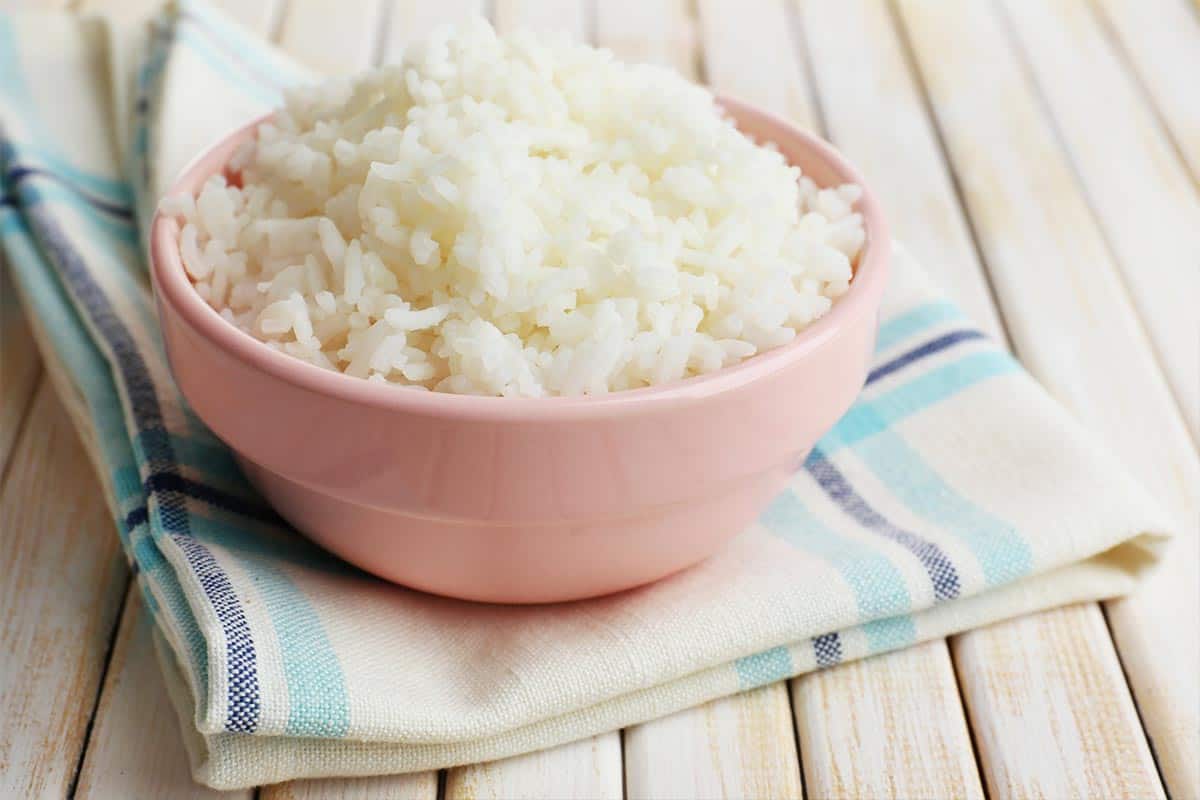
Raw to cooked white rice conversion: Raw weight ten three (example: 2oz raw ten three = 6oz cooked)
Cooked to raw white rice conversion: Cooked weight / 3 (example: 3oz cooked / 3 = 2oz uncooked)
White rice acts a piddling flake differently than brownish rice, and it will generally triple in size when cooked.
White rice is always my go-to when I guild takeout. If you find yourself with some cooked white rice and want to figure out the nutrition, y'all'll need to separate the weight by iii.
If you portion out 6 ounces of cooked white rice, dissever it by three to find that you lot are having the same nutrition as ii ounces of uncooked white rice.
Should y'all rail the raw or cooked weight of food?
If you're tracking your macros (or but your calories) it tin can be tough to figure out how to accurately counterbalance your portions.
My recommendation, if you can help it, is to always counterbalance your food raw. It takes away any guesswork and confusion, and it's consistent every time! Remember that the labels are always based on raw weight, so it makes your life the easiest.
Whether information technology'southward meat, potatoes, pasta, or rice, it's very helpful to counterbalance it out before you cook it. If you boil 4oz of rice, you know that y'all are making two 2oz servings- and then yous don't even have to carp weighing it out at the end.
To me, that'due south always the easiest way to go.
When information technology comes to meat, I e'er trim information technology down to the exact portion size I'd like. When it comes to chicken breast, I'll trim the raw chicken to the 8oz portion I want. Then when it'south cooked, information technology doesn't matter what the weight is! We know that it'll cook down to 6 ounces, only so we can play with marinades, sauces, and spices without whatever worry.
That being said, I totally empathise that sometimes y'all are not able to weigh your nutrient before it's prepared. If you lot're ordering takeout or eating a dish that somebody prepared, you may not have the option to weigh your food raw.
That's when these conversions come into play! While they may not be 100% accurate, they'll help you lot go very close.
When it comes to tracking macros, we don't need perfection anyhow- nosotros just want to exist close.
And if you want to calculate your own caloric or macronutrient needs, check out my complimentary Calorie & Macro Estimator! Information technology won't just spit numbers out to you, it will actually explicatewhy I recommend what I do to make things as easy as possible for you!
maldonadoouction1987.blogspot.com
Source: https://cheatdaydesign.com/tracking-macros-of-raw-vs-cooked-meat/

Post a Comment for "Calories in Raw Vs Cooked Beef"