What process do plants use to draw water up from their roots to their leaves?
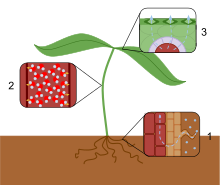
Overview of transpiration:
- Water is passively transported into the roots and and so into the xylem.
- The forces of cohesion and adhesion crusade the water molecules to course a column in the xylem.
- H2o moves from the xylem into the mesophyll cells, evaporates from their surfaces and leaves the plant past diffusion through the stomata

Transpiration of H2o in Xylem
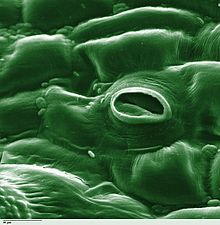
Transpiration is the process of water motility through a plant and its evaporation from aerial parts, such every bit leaves, stems and flowers. Water is necessary for plants just only a small amount of water taken up by the roots is used for growth and metabolism. The remaining 97–99.5% is lost by transpiration and guttation.[1] Leafage surfaces are dotted with pores chosen stomata (atypical "stoma"), and in most plants they are more numerous on the undersides of the foliage. The stomata are bordered past baby-sit cells and their stomatal accompaniment cells (together known every bit stomatal complex) that open and close the pore.[2] Transpiration occurs through the stomatal apertures, and can be thought of as a necessary "cost" associated with the opening of the stomata to allow the diffusion of carbon dioxide gas from the air for photosynthesis. Transpiration as well cools plants, changes osmotic pressure of cells, and enables mass menstruum of mineral nutrients and water from roots to shoots. 2 major factors influence the rate of water period from the soil to the roots: the hydraulic conductivity of the soil and the magnitude of the pressure slope through the soil. Both of these factors influence the rate of majority flow of water moving from the roots to the stomatal pores in the leaves via the xylem.[3]
Mass flow of liquid water from the roots to the leaves is driven in part past capillary action, merely primarily driven past h2o potential differences. If the water potential in the ambience air is lower than the water potential in the leaf airspace of the stomatal pore, water vapor will travel down the slope and motion from the leaf airspace to the atmosphere. This motility lowers the water potential in the foliage airspace and causes evaporation of liquid water from the mesophyll cell walls. This evaporation increases the tension on the water menisci in the cell walls and decrease their radius and thus the tension that is exerted on the water in the cells. Because of the cohesive backdrop of water, the tension travels through the leaf cells to the leaf and stem xylem where a momentary negative force per unit area is created as water is pulled up the xylem from the roots.[4] As evaporation occurs at the leafage surface, the properties of adhesion and cohesion piece of work in tandem to pull water molecules from the roots, through xylem tissue, and out of the found through stomata.[v] In taller plants and copse, the forcefulness of gravity tin can only be overcome by the decrease in hydrostatic (h2o) force per unit area in the upper parts of the plants due to the diffusion of h2o out of stomata into the atmosphere. Water is absorbed at the roots past osmosis, and any dissolved mineral nutrients travel with it through the xylem.
The cohesion-tension theory explains how leaves pull water through the xylem. H2o molecules stick together, or exhibit cohesion. Equally a water molecule evaporates from the surface of the leaf, it pulls on the adjacent h2o molecule, creating a continuous flow of water through the plant.[6]
Etymology [edit]
Nosotros can run into the history of the word transpiration when we interruption it down into trans, a Latin noun which means "across," and spiration, which comes from the Latin verb spīrāre, meaning "to breathe." The tion suffix adds the meaning "the human activity of," and so we can come across transpiration is, literally, "the Human activity
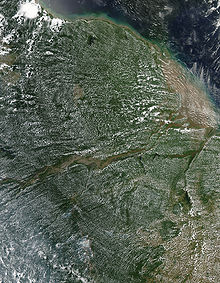
of breathing across," which clearly identifies vapor emission from plant leaves. Transpiration is vital to the earth'due south ecology, and is existence reduced by our decimation of the forests.
Capillary action [edit]
Capillary action is the process of a liquid flowing in narrow spaces without the help of, or even in opposition to, external forces like gravity. The outcome can exist seen in the drawing upward of liquids between the hairs of a pigment-brush, in a thin tube, in porous materials such every bit paper and plaster, in some non-porous materials such every bit sand and liquefied carbon fiber, or in a biological cell. It occurs because of intermolecular forces between the liquid and surrounding solid surfaces. If the bore of the tube is sufficiently small-scale, then the combination of surface tension (which is caused by cohesion within the liquid) and adhesive forces between the liquid and container wall human action to propel the liquid.[vii]
Regulation [edit]
Plants regulate the rate of transpiration by controlling the size of the stomatal apertures. The charge per unit of transpiration is besides influenced by the evaporative need of the atmosphere surrounding the foliage such as boundary layer conductance, humidity, temperature, air current and incident sunlight. Forth with to a higher place ground factors, soil temperature and moisture can influence stomatal opening,[8] and thus transpiration charge per unit. The amount of h2o lost by a plant likewise depends on its size and the amount of water absorbed at the roots. Transpiration accounts for nearly of the water loss by a plant by the leaves and young stems. Transpiration serves to evaporatively cool plants, as the evaporating h2o carries away heat free energy due to its large latent estrus of vaporization of 2260 kJ per litre.
| Feature | Effect on transpiration |
|---|---|
| Number of leaves | More leaves (or spines, or other photosynthesizing organs) means a bigger surface area and more than stomata for gaseous commutation. This will consequence in greater water loss. |
| Number of stomata | More stomata will provide more than pores for transpiration. |
| Size of the leaf | A leaf with a bigger surface area volition transpire faster than a leaf with a smaller area. |
| Presence of plant cuticle | A waxy cuticle is relatively impermeable to h2o and water vapour and reduces evaporation from the found surface except via the stomata. A reflective cuticle will reduce solar heating and temperature rise of the leaf, helping to reduce the charge per unit of evaporation. Tiny pilus-similar structures called trichomes on the surface of leaves also can inhibit water loss by creating a high humidity environs at the surface of leaves. These are some examples of the adaptations of plants for conservation of water that may be found on many xerophytes. |
| Light supply | The rate of transpiration is controlled by stomatal discontinuity, and these small pores open particularly for photosynthesis. While there are exceptions to this (such as night or CAM photosynthesis), in general a lite supply will encourage open stomata. |
| Temperature | Temperature affects the rate in two means: i) An increased rate of evaporation due to a temperature rise will hasten the loss of water. |
| Relative humidity | Drier environs gives a steeper h2o potential gradient, then increases the charge per unit of transpiration. |
| Wind | In still air, water lost due to transpiration can accrue in the form of vapor close to the leaf surface. This will reduce the rate of water loss, as the water potential gradient from inside to exterior of the leafage is and then slightly less. Wind blows abroad much of this water vapor near the leaf surface, making the potential gradient steeper and speeding up the diffusion of water molecules into the surrounding air. Fifty-fifty in current of air, though, in that location may exist some accumulation of water vapor in a sparse boundary layer of slower moving air next to the leaf surface. The stronger the air current, the thinner this layer volition tend to be, and the steeper the water potential gradient. |
| H2o supply | Water stress caused past restricted h2o supply from the soil may result in stomatal closure and reduce the rates of transpiration. |
-

The consequence of temperature on the transpiration rate of plants.
-
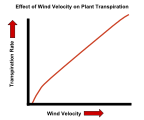
The outcome of wind velocity on the transpiration charge per unit of plants.
-

The upshot of humidity on the transpiration rate of plants.

Some xerophytes will reduce the surface of their leaves during h2o deficiencies (left). If temperatures are cool enough and water levels are adequate the leaves expand again (right).
During a growing season, a leaf will transpire many times more h2o than its own weight. An acre of corn gives off most three,000–4,000 gallons (11,400–15,100 liters) of h2o each day, and a large oak tree can transpire 40,000 gallons (151,000 liters) per twelvemonth. The transpiration ratio is the ratio of the mass of water transpired to the mass of dry matter produced; the transpiration ratio of crops tends to autumn betwixt 200 and 1000 (i.e., ingather plants transpire 200 to k kg of water for every kg of dry thing produced).[9]
Transpiration rates of plants can be measured past a number of techniques, including potometers, lysimeters, porometers, photosynthesis systems and thermometric sap flow sensors. Isotope measurements indicate transpiration is the larger component of evapotranspiration.[ten] Recent prove from a global written report[11] of water stable isotopes shows that transpired water is isotopically different from groundwater and streams. This suggests that soil water is non as well mixed as widely assumed.[12]
Desert plants have especially adapted structures, such as thick cuticles, reduced foliage areas, sunken stomata and hairs to reduce transpiration and conserve water. Many cacti comport photosynthesis in succulent stems, rather than leaves, and then the surface area of the shoot is very low. Many desert plants have a special type of photosynthesis, termed crassulacean acid metabolism or CAM photosynthesis, in which the stomata are closed during the twenty-four hour period and open at nighttime when transpiration volition be lower.
Cavitation [edit]
To maintain the pressure gradient necessary for a plant to remain healthy they must continuously uptake h2o with their roots. They need to exist able to meet the demands of h2o lost due to transpiration. If a plant is incapable of bringing in enough h2o to remain in equilibrium with transpiration an consequence known every bit cavitation occurs.[thirteen] Cavitation is when the plant cannot supply its xylem with adequate water and so instead of being filled with water the xylem begins to exist filled with h2o vapor. These particles of h2o vapor come up together and grade blockages within the xylem of the institute. This prevents the found from being able to transport water throughout its vascular system.[xiv] There is no credible pattern of where cavitation occurs throughout the plant'south xylem. If not effectively taken care of, cavitation tin cause a found to achieve its permanent wilting point, and die. Therefore, the plant must take a method by which to remove this cavitation blockage, or information technology must create a new connectedness of vascular tissue throughout the plant.[fifteen] The constitute does this by closing its stomates overnight, which halts the period of transpiration. This then allows for the roots to generate over 0.05 mPa of pressure, and that is capable of destroying the blockage and refilling the xylem with water, reconnecting the vascular system. If a establish is unable to generate enough pressure to eradicate the blockage it must forbid the blockage from spreading with the utilize of pit pears and and then create new xylem that tin re-connect the vascular system of the institute.[16]
Scientists have begun using magnetic resonance imaging (MRI) to monitor the internal status of the xylem during transpiration, in a non invasive way. This method of imaging allows for scientists to visualize the motion of water throughout the entirety of the plant. It also is capable of viewing what phase the water is in while in the xylem, which makes it possible to visualize cavitation events. Scientists were able to see that over the course of xx hours of sunlight more than than 10 xylem vessels began filling with gas particles becoming cavitated. MRI technology also fabricated information technology possible to view the process by which these xylem structures are repaired in the establish. After three hours in darkness it was seen that the vascular tissue was resupplied with liquid water. This was possible because in darkness the stomates of the plant are airtight and transpiration no longer occurs. When transpiration is halted the cavitation bubbles are destroyed past the force per unit area generated by the roots. These observations suggest that MRIs are capable of monitoring the functional status of xylem and allows scientists to view cavitation events for the first time.[15]
Meet also [edit]
- Antitranspirant – a substance to prevent transpiration
- Canopy conductance
- Ecohydrology
- Eddy covariance flux (aka eddy correlation, eddy flux)
- Hydrology (agronomics)
- Latent heat flux
- Perspiration
- Soil plant atmosphere continuum
- Stomatal conductance
- Transpiration stream
- Turgor pressure
- Water Evaluation And Planning system (WEAP)
References [edit]
- ^ Sinha, Rajiv Kumar (2004-01-01). Modern Plant Physiology. CRC Press. ISBN978-0-8493-1714-9.
- ^ Benjamin Cummins (2007), Biological Scientific discipline (3 ed.), Freeman, Scott, p. 215
- ^ Taiz, Lincoln (2015). Institute Physiology and Evolution. Sunderland, MA: Sinauer Assembly, Inc. p. 101. ISBN978-1-60535-255-eight.
- ^ Freeman, Scott (2014). Biological Sciences. Us: Pearson. pp. 765–766. ISBN978-0-321-74367-1.
- ^ Simon, E.J., Dickey, J.L, & Reece, J.B. (2019). Campbell essential biology. 7th New York: Pearson
- ^ Graham, Linda E. (2006). Plant Biology. Upper Saddle River, NJ 07458: Pearson Pedagogy, Inc. pp. 200–202. ISBN978-0-xiii-146906-eight.
{{cite volume}}: CS1 maint: location (link) - ^ "Capillary Action – Liquid, Water, Forcefulness, and Surface – JRank Articles". Scientific discipline.jrank.org. Archived from the original on 2013-05-27. Retrieved 2013-06-18 .
- ^ Mellander, Per-Erik; Bishop, Kevin; Lundmark, Tomas (2004-06-28). "The influence of soil temperature on transpiration: a plot scale manipulation in a immature Scots pine stand up". Wood Ecology and Management. 195 (1): 15–28. doi:x.1016/j.foreco.2004.02.051. ISSN 0378-1127.
- ^ Martin, J.; Leonard, Due west.; Postage, D. (1976), Principles of Field Crop Product (tertiary ed.), New York: Macmillan Publishing Co., ISBN978-0-02-376720-3
- ^ Jasechko, Scott; Sharp, Zachary D.; Gibson, John J.; Birks, South. Jean; Yi, Yi; Fawcett, Peter J. (3 April 2013). "Terrestrial water fluxes dominated by transpiration". Nature. 496 (7445): 347–fifty. Bibcode:2013Natur.496..347J. doi:x.1038/nature11983. PMID 23552893. S2CID 4371468.
- ^ Evaristo, Jaivime; Jasechko, Scott; McDonnell, Jeffrey J. (2015-09-03). "Global separation of plant transpiration from groundwater and streamflow". Nature. 525 (7567): 91–94. Bibcode:2015Natur.525...91E. doi:10.1038/nature14983. ISSN 0028-0836. PMID 26333467. S2CID 4467297.
- ^ Bowen, Gabriel (2015-09-03). "Hydrology: The diversified economics of soil water". Nature. 525 (7567): 43–44. Bibcode:2015Natur.525...43B. doi:x.1038/525043a. ISSN 0028-0836. PMID 26333464. S2CID 205086035.
- ^ Zhang, Yong-Jiang (December 2016). "Reversible Leaf Xylem Collapse: A Potential "Excursion Breaker" against Cavitation". Constitute Physiology. 172 (iv): 2261–2274. doi:x.1104/pp.16.01191. PMC5129713. PMID 27733514.
- ^ Hochberg, Uri (June 2017). "Stomatal Closure, Basal Leaf Embolism, and Shedding Protect the Hydraulic Integrity of Grape Stems". Plant Physiology. 174 (2): 764–775. doi:ten.1104/pp.xvi.01816. PMC5462014. PMID 28351909.
- ^ a b Holbrook, Michele (May 2001). "In Vivo Ascertainment of Cavitation and Embolism Repair Using Magnetic Resonance Imaging". Plant Physiology. 126 (i): 27–31. doi:10.1104/pp.126.1.27. PMC1540104. PMID 11351066.
- ^ Tiaz, Lincoln (2015). Plant Physiology and Development. Massachusetts: Sinauer Assembly, Inc. p. 63. ISBN978-1605352558.
External links [edit]
- USGS The Water Bike: Evapotranspiration
maldonadoouction1987.blogspot.com
Source: https://en.wikipedia.org/wiki/Transpiration

Post a Comment for "What process do plants use to draw water up from their roots to their leaves?"