To You Have to Go to Basics Again Switching Branches
Git Co-operative

This document is an in-depth review of the git branch command and a give-and-take of the overall Git branching model. Branching is a feature available in most modernistic version control systems. Branching in other VCS's can exist an expensive operation in both fourth dimension and disk space. In Git, branches are a function of your everyday development process. Git branches are finer a pointer to a snapshot of your changes. When you want to add a new feature or fix a bug—no affair how large or how small—you spawn a new branch to encapsulate your changes. This makes it harder for unstable code to become merged into the main code base, and it gives you the chance to clean up your futurity's history before merging it into the main branch.
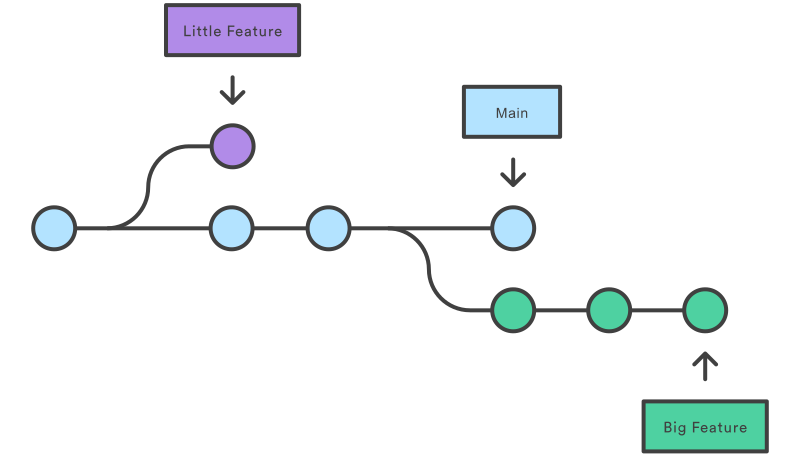
The diagram above visualizes a repository with ii isolated lines of development, ane for a fiddling feature, and i for a longer-running characteristic. By developing them in branches, information technology'due south not only possible to work on both of them in parallel, just it too keeps themain branch free from questionable code.
The implementation behind Git branches is much more lightweight than other version control system models. Instead of copying files from directory to directory, Git stores a branch equally a reference to a commit. In this sense, a co-operative represents the tip of a series of commits—it's non a container for commits. The history for a branch is extrapolated through the commit relationships.
As you read, remember that Git branches aren't like SVN branches. Whereas SVN branches are only used to capture the occasional large-scale development endeavor, Git branches are an integral office of your everyday workflow. The following content will expand on the internal Git branching compages.
How information technology works
A branch represents an independent line of development. Branches serve as an brainchild for the edit/phase/commit procedure. You can think of them equally a manner to request a make new working directory, staging expanse, and project history. New commits are recorded in the history for the current branch, which results in a fork in the history of the projection.
The git branch command lets yous create, list, rename, and delete branches. It doesn't let you switch between branches or put a forked history back together again. For this reason, git branch is tightly integrated with the git checkout and git merge commands.
Common Options
Listing all of the branches in your repository. This is synonymous with git branch --listing.
Create a new branch chosen <branch>. This does not check out the new branch.
Delete the specified branch. This is a "safe" operation in that Git prevents you from deleting the branch if it has unmerged changes.
Strength delete the specified co-operative, even if information technology has unmerged changes. This is the control to utilize if you lot want to permanently throw abroad all of the commits associated with a detail line of evolution.
Rename the current branch to <branch>.
List all remote branches.
Creating Branches
It'south important to understand that branches are just pointers to commits. When y'all create a branch, all Git needs to practice is create a new pointer, it doesn't modify the repository in any other way. If you beginning with a repository that looks like this:

Then, y'all create a co-operative using the following command:
git branch crazy-experiment The repository history remains unchanged. All you go is a new pointer to the current commit:
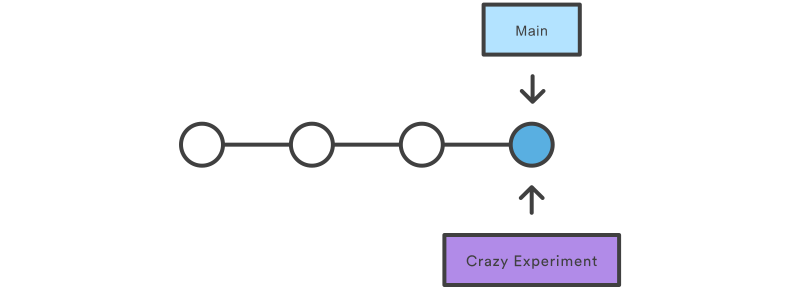
Note that this but creates the new branch. To start calculation commits to it, you need to select it with git checkout, and then use the standard git add and git commit commands.
Creating remote branches
So far these examples have all demonstrated local branch operations. The git co-operative control too works on remote branches. In order to operate on remote branches, a remote repo must first be configured and added to the local repo config.
              $ git remote add new-remote-repo https://bitbucket.com/user/repo.git
# Add remote repo to local repo config
$ git push <new-remote-repo> crazy-experiment~
# pushes the crazy-experiment co-operative to new-remote-repo
This command will push button a copy of the local co-operative crazy-experiment to the remote repo <remote>.
Deleting Branches
Once you lot've finished working on a co-operative and have merged it into the main lawmaking base, you're costless to delete the branch without losing any history:
git branch -d crazy-experiment Still, if the branch hasn't been merged, the above control volition output an error bulletin:
mistake: The co-operative 'crazy-experiment' is non fully merged. If you are sure you lot want to delete information technology, run 'git co-operative -D crazy-experiment'. This protects you from losing access to that entire line of development. If you really want to delete the branch (e.g., it's a failed experiment), y'all tin apply the majuscule -D flag:
git co-operative -D crazy-experiment This deletes the branch regardless of its status and without warnings, so utilise it judiciously.
The previous commands volition delete a local copy of a co-operative. The co-operative may still exist in remote repos. To delete a remote branch execute the following.
git push origin --delete crazy-experiment Or
git push origin :crazy-experiment This will push a delete signal to the remote origin repository that triggers a delete of the remote crazy-experiment branch.
Summary
In this document we discussed Git's branching behavior and the git branch control. The git co-operative commands primary functions are to create, list, rename and delete branches. To operate further on the resulting branches the command is commonly used with other commands like git checkout. Larn more near git checkout branch operations; such as switching branches and merging branches, on the git checkout page.
Compared to other VCSs, Git's co-operative operations are inexpensive and often used. This flexibility enables powerful Git workflow customization. For more info on Git workflows visit our extended workflow discussion pages: The Feature Branch Workflow, GitFlow Workflow, and Forking Workflow.
maldonadoouction1987.blogspot.com
Source: https://www.atlassian.com/git/tutorials/using-branches

Post a Comment for "To You Have to Go to Basics Again Switching Branches"